
The guide to choosing the right custom-made tabletop
In short
Choosing a made-to-measure table top comes down to four criteria that need to work together: the dimensions (allow around 60 cm per person and a width of 90 to 100 cm for good comfort), the thickness (between 40 and 50 mm depending on the wood species and the style you're after), the wood species (oak, acacia, reclaimed wood or mango, each with its own character) and the technical balance with the base, taking into account the weight of solid wood and its natural expansion and contraction. Thought through together, these elements turn a simple table top into a true centerpiece of the dining room.
Custom-made tabletop: dimensions, thickness, wood species… how do you make the right choice?
You’ve found the perfect base. Or the ideal space in your dining room. But one key question remains: which tabletop should you choose?
When it comes to a custom-made tabletop, we’re rarely talking about a simple piece of wood. Dimensions, thickness, wood species, stability, everyday use… every decision influences the final result. And the wrong choice can turn a beautiful table into a frustrating project.
On the other hand, a well-designed custom-made tabletop changes everything: balanced proportions, the right wood, harmony with the base, and everyday comfort. This is what turns a table into a true centerpiece in your living space.
Many people start their project by focusing only on the length or style of the tabletop. Yet the success of a custom-made dining tabletop depends on several elements working together: the wood, thickness, size… but also the space around the table and the type of base chosen.
In this article, we’ll walk through the key factors to consider when choosing a solid wood tabletop that is durable, aesthetically pleasing, and perfectly suited to your interior.
Ideal dimensions, tabletop thickness, wood selection, common mistakes to avoid… you’ll discover that behind every beautiful tabletop lie a few simple—but essential—rules.
Why choose a custom-made tabletop instead of a standard model?
Tables sold in stores almost always follow the same standard sizes: 160 cm, 180 cm, 200 cm… and sometimes 220 cm.
But as soon as a project falls outside the norm—a narrow room, a large family, or an open-plan space—these standard dimensions can quickly become limiting.
With a custom-made tabletop, you can tailor the proportions precisely: a length between standard sizes, a different width, or a more generous tabletop to accommodate additional guests.
The result is often more harmonious… and above all, more comfortable for everyday living.
Adapting the tabletop to an existing base
This is a very common situation: you already have a table base, or you’ve found a base that you really love.
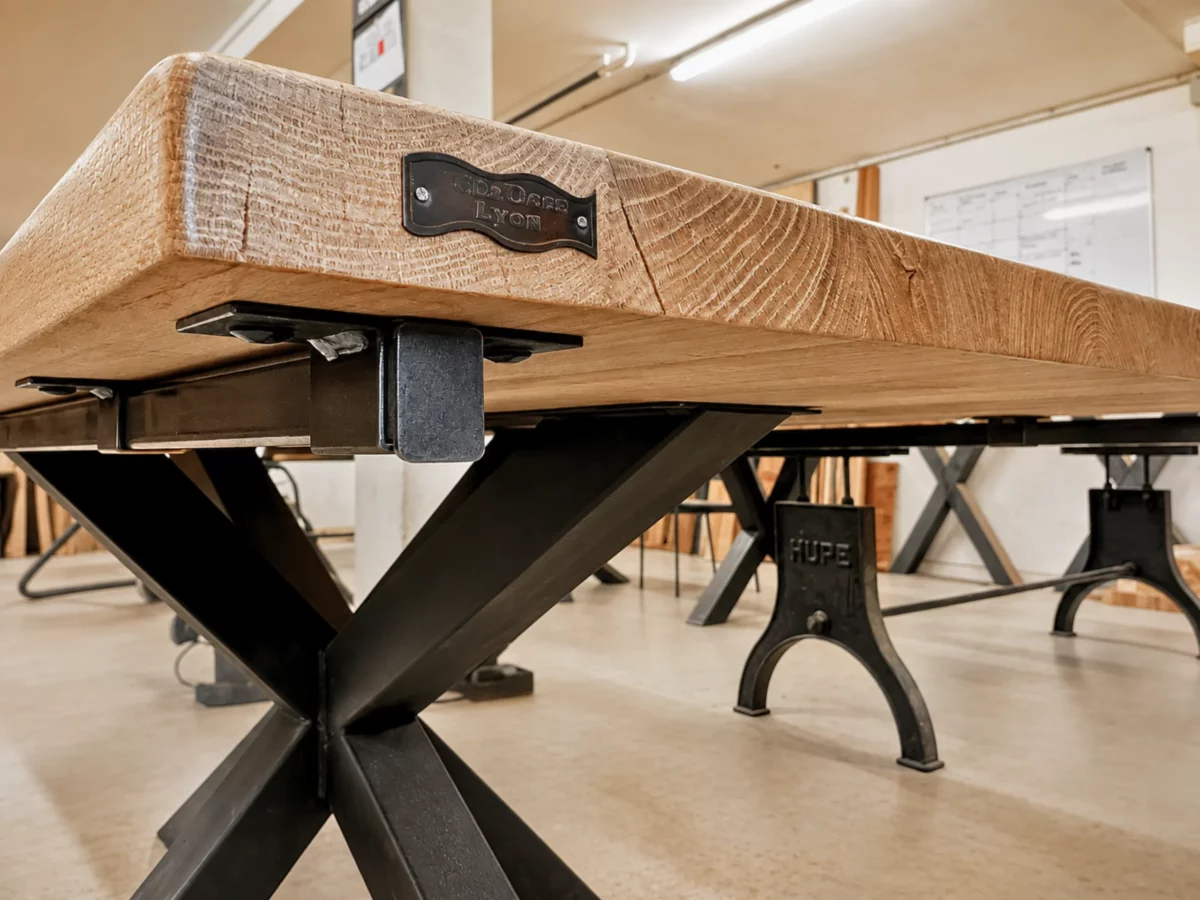
In this case, a custom-made tabletop allows you to perfectly adapt the tabletop to the existing structure: exact dimensions, fixing positions, and visual balance.
It’s also an excellent way to give a second life to an old base or a designer frame while creating a truly unique table.
Making the most of an unusual space or a large dining table
Some spaces require specific dimensions: an open-plan dining room, a large family kitchen, a room with sloped ceilings, or, on the contrary, a more compact dining area.
n these situations, a custom-made dining tabletop allows you to make the most of the available space. The dimensions can be tailored to maintain comfortable circulation around the table while ensuring a pleasant dining experience.
It is also the best solution for large gatherings. When you need a table that seats 8, 10, or even 12 people, standard sizes quickly become limiting.
With a custom-made solid wood tabletop, you can create a perfectly proportioned table that comfortably accommodates everyone without compromise.
What are the right dimensions for a made-to-measure table top?
Dimensions are often the first thing people think about… yet they are also the source of the most common mistakes. Too small, and the table quickly becomes uncomfortable. Too large, and it overwhelms the room and makes movement around it more difficult.
The advantage of a custom-made tabletop is precisely that it allows you to find the right balance between seating capacity, proportions, and available space. The length, width, and surrounding area all need to work together harmoniously.
What tabletop length should you choose based on the number of guests?
To keep a table comfortable, it is generally recommended to allow around 60 cm (24 inches) per person. This simple rule provides a good starting point when estimating the ideal table size.
For example:
- 120 cm is generally enough to comfortably seat 4 people
- 160 to 180 cm is ideal for comfortably seating 6 people
- 200 to 220 cm can comfortably accommodate 8 people
- 240 to 260 cm provides a true dining table for 10 guests
With a custom-made tabletop, these dimensions can be adjusted more precisely. For example, you can choose an intermediate length to make the most of your space, or opt for a more generous size to accommodate large family gatherings comfortably.
What width should you choose for optimal comfort?
The width of a tabletop is often underestimated. Yet it has a direct impact on dining comfort.
For a rectangular table, a width of 90 to 100 cm is generally ideal:
- it provides enough space to comfortably accommodate plates, serving dishes, and glasses;
- it also leaves enough room in the center for shared dishes and serving platters.
Below 80 cm, the table quickly becomes restrictive for shared meals. On the other hand, beyond 110 cm, guests may find it more difficult to converse comfortably or reach dishes placed in the center of the table.
In a custom-made dining tabletop project, adjusting the width is often the key to finding the right balance between conviviality and ease of movement around the table.
How much space should you leave around the table?
The size of the tabletop is only part of the equation. The space around the table is just as important.
For comfortable everyday use, it is recommended to allow at least 90 cm of clearance between the table and a wall or piece of furniture. This distance makes it easy to pull out chairs and move around without restriction.
In a more open space or a spacious dining room, allowing 100 to 120 cm of clearance provides an even greater level of comfort.
This is exactly where a custom-made wooden tabletop comes into its own: instead of trying to fit a standard table into a space that doesn’t suit it, the table dimensions are tailored to the room itself.
If you’d like to explore table dimensions in more detail based on the table shape (round, rectangular, or square), take a look at our dedicated guide:
→ What table dimensions should you choose?
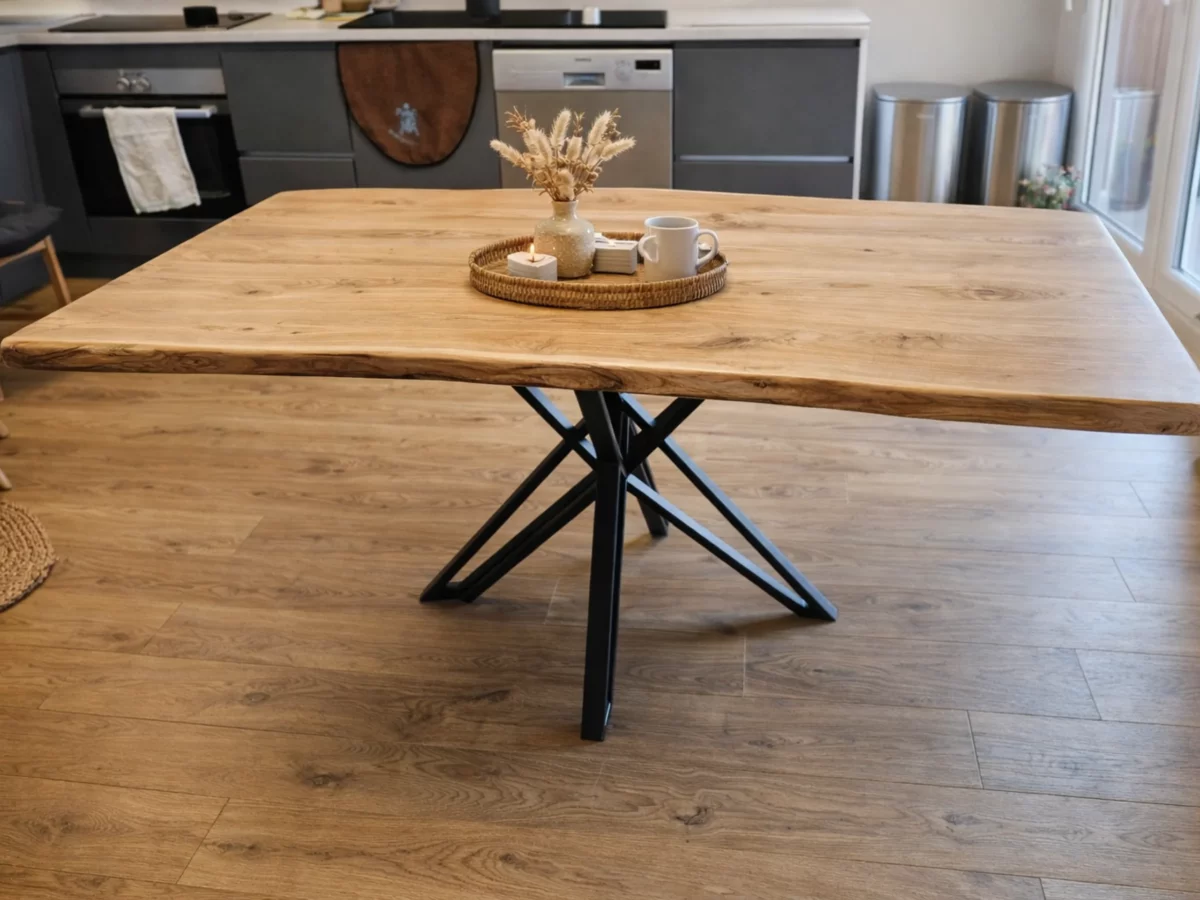
What thickness should you choose for a custom-made tabletop?
When imagining a table, most people focus on its dimensions or the wood species. Yet the thickness of the tabletop plays a key role in its appearance, strength, and everyday comfort.
A tabletop that is too thin can feel fragile and lack visual presence. On the other hand, an overly thick tabletop can make the table appear heavy and may even complicate installation and handling.
In a custom tabletop project, the thickness should therefore be chosen according to several factors: the size of the table, the type of base, the desired style, and sometimes even access constraints within the room where the table will be installed.
40 mm, 45 mm, or 50 mm: what are the visual and technical differences?
At VitaDeco, tabletop thickness varies depending on the wood species selected.
Solid oak is available in a thickness of 40 mm, while acacia, reclaimed wood, and mango wood are offered in thicknesses ranging from 45 to 50 mm.
The 40 mm thickness offers a balanced and timeless look. It provides visual presence without making the table feel heavy, while maintaining a sense of elegance and lightness.
The 45 to 50 mm thicknesses give the tabletop even more character. The wood feels more substantial and visually impactful, reinforcing the table’s authentic and statement-making presence.
This type of thickness is particularly well suited to large tabletops or projects where the table is intended to become a true centerpiece of the room.
The choice therefore depends not only on the wood species and the desired style, but also on the overall balance between the tabletop and the table base.
What is the impact of thickness on stability?
The thickness of the tabletop also has a direct impact on the overall stability of the table. The larger the tabletop, the more important it is for it to remain rigid and stable over time.
A custom-made tabletop designed for a large table (200 cm or more) often benefits from a greater thickness, which helps reduce the natural movement of the wood and improves the overall rigidity of the structure.
But thickness alone is not enough. Stability also depends on:
- the wood species selected,
- the type of assembly and gluing process used,
- and, above all, the table base used.
A successful custom tabletop project always involves considering the balance between the tabletop and the base.
Weight: an often underestimated factor
It is often overlooked, but solid wood is heavy. Very heavy.
A large tabletop can quickly weigh several dozen kilograms, especially with thicknesses of 45 to 50 mm.
For example, a 200 × 100 cm solid wood tabletop can weigh more than 70 kg, depending on the wood species and thickness selected.
This has several implications:
- transportation and installation need to be planned in advance;
- the table base must be strong enough to support the weight;
- and in some cases, access to the room (stairs, hallways, and doorways) must also be taken into consideration.
That is why a custom-made tabletop project should always be considered as a whole, going well beyond simple aesthetic choices.
Which wood should you choose for a custom-made tabletop?
Choosing a wood species is not just about aesthetics. The type of wood influences the table’s visual character, durability, weight, and even the way it will age over time.
A custom-made solid wood tabletop should therefore be selected according to its intended use, the desired style, and the overall atmosphere of the room. Some wood species bring warmth and balance, while others create stronger contrast or a more rustic character.
Here are the wood species most commonly used for a custom-made tabletop.
Solid oak: balance and timeless appeal
Oak is one of the most widely used wood species for furniture and tables. Dense and durable, it withstands everyday wear and impact very well, making it a particularly reliable choice for a tabletop.
Visually, oak features a distinctive grain and shades ranging from light honey tones to deeper browns. It is a versatile wood that fits easily into many interior styles, including contemporary, Scandinavian, rustic, and industrial designs.
For a balanced and long-lasting project, a custom-made oak tabletop remains one of the safest and most timeless choices.
→ Discover:
Solid oak tabletops
Acacia: character and contrast
Acacia is appreciated for its highly distinctive appearance. Its colour variations, ranging from golden brown to deeper dark tones, create a tabletop rich in contrast and visual depth.
It is also a dense and durable wood, valued in furniture making for its strength and resistance to everyday wear.
A custom-made acacia wood tabletop often becomes a striking focal point within a living space, particularly in industrial, contemporary, or bohemian interiors.
→ Discover:
Solid acacia tabletop
Reclaimed wood: raw authenticity
Reclaimed wood brings a character that is impossible to replicate with new timber. Marks of time, natural irregularities, and deep, rich tones mean that every tabletop tells its own story.
Made from reclaimed or recycled timber, this type of custom-made tabletop appeals to those looking for an authentic look with plenty of character and personality.
It is also a more responsible choice: a custom-made reclaimed wood tabletop gives a noble material a second life while creating a truly unique piece.
→ Discover:
Reclaimed wood tabletop
Mango wood: warmth and individuality
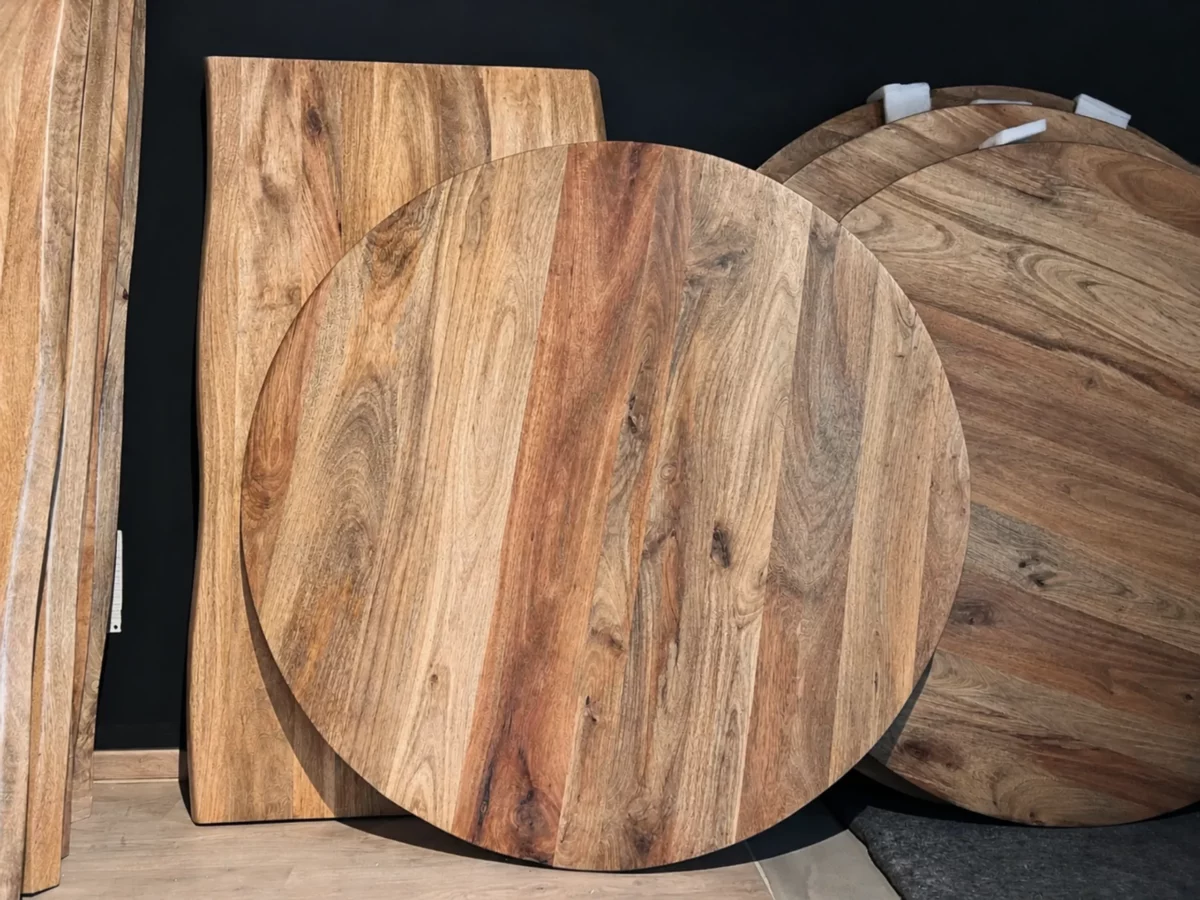
Mango wood is becoming increasingly popular in furniture design. Its timber features warm tones and often striking grain patterns, making each tabletop truly unique.
Less dense than some European wood species, it offers a warm and contemporary look while remaining perfectly suited to furniture making when properly protected and finished.
A custom-made mango wood dining tabletop works particularly well in modern, natural, or subtly exotic interiors.
→ Discover:
Solid mango wood tabletop
Curious to see how a table top takes shape, from selecting the wood to the final assembly? Our article how a table top is made covers each step in detail.
What mistakes should you avoid before ordering a made-to-measure table top?
A custom-made tabletop allows you to create a table perfectly suited to your space. However, before production begins, there are several important points that should be carefully considered.
In most projects, mistakes are not related to the choice of wood or style, but rather to technical details that are often overlooked. The weight of the tabletop, compatibility with the base, and the natural characteristics of wood can make all the difference between a table that works perfectly and one that becomes difficult to live with every day.
Here are the most common pitfalls to avoid.
Underestimating the weight of solid wood
Solid wood is a noble material—but it is also very dense. The larger and thicker the tabletop, the more quickly its weight increases.
A large custom-made solid wood tabletop can easily weigh several dozen kilograms. For a table measuring 200 cm in length, the weight can reach 60 to 80 kg depending on the wood species and thickness chosen.
This weight affects several aspects of the project:
- the strength of the table base;
- the ease of transport and installation;
- access to the room (stairs, hallways, and doorways).
Anticipating these factors helps avoid unpleasant surprises on delivery day.
Overlooking the compatibility between the tabletop and the base
The tabletop and the base need to work together as a whole. Yet it is common for people to choose a tabletop without fully considering its balance and compatibility with the base.
A custom-made tabletop that is too large for a small base can lead to stability issues. Conversely, an overly bulky base paired with a thin tabletop can make the table feel visually unbalanced.
The ideal approach is to consider the entire table as a whole from the very beginning:
- the tabletop proportions,
- the type of base (central pedestal, X-shaped legs, straight legs, etc.),
- the position of the fixing points.
A successful table always relies on the right balance between the tabletop and the base.
Overlooking technical constraints (wood movement and fixing systems)
Solid wood is a living material. It naturally reacts to changes in humidity and temperature, causing slight expansion and contraction throughout the seasons.
A custom-made wooden tabletop must therefore be fixed in a way that allows the wood to move naturally without restriction. The fixing system should accommodate these natural movements while maintaining the stability of the table.
This is a technical detail that often goes unnoticed… but it is essential for preventing warping, stress, and deformation in the wood over time.
In a custom-made tabletop project, these details are an integral part of the design process. They help ensure the durability and stability of the table for many years to come.
How does a custom-made tabletop project work at VitaDeco?
Creating a custom-made tabletop is about much more than choosing a size and a wood species. Every project is an opportunity to design a piece tailored to a specific interior, intended use, and aesthetic vision.
At VitaDeco, the goal is simple: to guide you through the project so that your custom-made tabletop integrates perfectly with the room, the base, and the lifestyle of its future users.
Consultation and technical validation
Every project begins with a discussion about your needs and vision. The table dimensions, number of guests, type of base, and desired style all help define the foundations of your future custom-made tabletop.
This initial stage is also used to validate several technical aspects:
- the tabletop proportions,
- the appropriate tabletop thickness,
- the wood species,
- compatibility with the table base.
The goal is to find the right balance between aesthetics, stability, and long-term durability.
Visit to the workshop
Delivery and installation
Once the project has been approved, production of your custom-made solid wood tabletop begins. Each piece is carefully prepared and assembled to ensure strength and stability.
After production, the table can be:
- collected directly from the workshop,
- or delivered using a transport service suited to furniture.
The goal remains the same: for the tabletop to arrive in the best possible condition and quickly become the centerpiece of your dining room.
To learn more about the full process of a made-to-measure project, from booking your appointment to delivery, check out our article on the VitaDeco workshop.
Key takeaways: choosing your table top
Theme
Key points
Dimensions
Allow around 60 cm per person, a width of 90 to 100 cm, and at least 90 to 120 cm of free space around the table
Thickness
Wood species
Oak (timeless), acacia (contrasting), reclaimed wood (raw and authentic), mango (warm and distinctive)
Technical balance
Check compatibility with the base, plan for the weight of solid wood, and use fixings that allow the wood to expand and contract
Frequently Asked Questions
How many people can a 180 cm table seat?
What thickness of table top should you choose for a large table?
Which wood is the strongest for a table top?
Oak is known for its density and its resistance to knocks and everyday wear, making it a reliable choice for a durable table top.
Why is a solid wood table top so heavy?
How can you prevent warping caused by the wood's expansion and contraction?
Can a made-to-measure table top be adapted to fit an existing table base?
We are making an appointment at the workshop.
58 Pasteur Street
69780 Saint Pierre de Chandieu
We advise and assist you
to choose the best size
for your future table
We advise you
on the choice of wood type
for your tray
What type of foot will accompany
your tray to complete
the table of your dreams
Once the table is created,
we are preparing it for you so that it is
absolutely perfect
We are delivering your table
at home, or you can pick it up
to the workshop directly
Book an appointment at the workshop
Do you have an idea, specific size constraints or simply want a truly unique table? Come and discover our solid wood tabletops, explore our different table bases and let’s discuss your project together. Every VitaDeco table is designed to suit your interior — not the other way around.

 D C27/08/2025
Trustindex vérifie que la source originale de l'avis est Google.
Un grand merci à Vincent et son équipe de Vitadeco ! Nous avons trouvé dans leur atelier près de Lyon la table en bois parfaite, et elle nous a été livrée rapidement en Savoie. Enfin une belle table qui correspond exactement à ce que nous cherchions : élégante, solide et pleine de charme. Bravo pour la qualité du travail et le service irréprochable 👌✨Publié sur Google
 Gaelle M.19/08/2025Nous sommes ravis de notre achat et de la livraison de notre table sur mesure ! Tout a pu se faire à distance - nous aurions adoré voir l'atelier en personne mais habitant à Paris ce n'était pas simple... Vincent et son équipe sont des passionnés et cela se ressent ! Merci encore.Publié sur Google
 sami charef24/07/2025Très satisfait concernant l'achat de ma table. Livraison efficace sur paris. Je recommande.Publié sur Google
 Arnaud16/06/2025Très bons conseils et énormément de choix. Toutes les tables sont magnifiques. Merci encore!!Publié sur Google
 Valerie bournel BoSson03/05/20255 années de recherche pour trouver une belle table, un bel objet comme on dit et à un prix raisonnable, merci Vincent Esposito, un pro.Publié sur Google
 Ghislaine Réveil02/04/2025Nous sommes enchantés de notre table (diamètre 110 cm). Établissement très sérieux de la confection à la livraison, à recommander sans hésitation.Publié sur Google
 Break Viss02/04/2025We came all the way from Paris and found our dream table with the help of Vincent. He was incredibly patient during our visit, pulled out table after table for us to explore, until we found the right one with the right legs. In the end we chose a beautiful table made of wood over 100 years old; it's a piece that oozes history and that has texture and character that you will not find if you buy "off the rack" in some overpriced designer store. The price was extremely competitive compared to what you find in stores in Paris, if you were to be able to find something like this in the first place. I highly recommend VitaDeco to anyone considering buying a custom table in France!Publié sur Google
 Tis 5528/03/2025Je suis très contente de l'achat de ma table chez vitadeco qui correspond tout à fait à mes attentes. Compter environ un peu plus de 1mois pour la fabrication d une table sur mesure et de qualité. Un très bon contact avec Vincent qui est toujours de bon conseil pour les clients.J'étais un peu plus septique pour la livraison à mon domicile en Marne mais cela s'est très bien passé par cocolis. Je recommande vivement cette entreprise.Publié sur Google
 Clément I13/12/2024Nous sommes enthousiasmé par la table que nous a fabriqué Vitadeco. Nous avons pu échanger, discuter et finaliser les choix de composition de notre table. Vitadeco se distingue particulièrement par sa disponibilité et son professionalisme. Nous recommandons vivement cette entreprise pour vos projet.Publié sur Google
 Marion BRAIRE07/12/2024Nous possédons une table ( en bois avec pieds en métal) achetée chez Vita Déco il y a plusieurs années, et elle est restée à l’identique! Très bon rapport qualité-prix et fabricant très sympa. On recommande!!!Publié sur Google