

How to vitrify a wood table for lasting protection?
In short
Vitrifying a wood table creates a water-resistant barrier against stains, scratches and moisture, while enhancing the natural grain. Preparation involves sanding with 120 grit along the direction of the grain, then applying with an 18 cm roller (a brush for the edges), in 3 to 4 coats with 4 hours of drying time between each. At VitaDeco, Blanchon's Océanic raw wood vitrifier is favoured for its ultra-matte, natural finish; for a more eco-friendly option, Rubio Monocoat oils remain an alternative, offering somewhat less protection.
Why use a vitrifier for a wood dining table?
A vitrifier for a dining table is essential to preserve the durability and good looks of the wood. By forming a protective barrier, it effectively prevents stains, scratches and moisture infiltration. But that's not all: it also enhances the wood's natural grain. As well as extending your table's lifespan, this finish gives a smooth, elegant look that showcases the tone and shades of the solid wood. This applies whether the table is oak, acacia or mango. Vitrifying preserves the wood's natural appearance while giving it lasting everyday protection.
By choosing this technique, you're opting for a practical, easy-to-maintain solution, while guaranteeing optimal resistance against frequent use and the wear and tear of daily life.
What is wood vitrification?
Wood vitrification is a finishing technique that involves applying a protective product to the surface of the wood. This process creates a resistant, waterproof layer. This effectively protects the wood from external stresses such as water, stains and scratches.
Ideal for solid wood tables, vitrification maintains the wood's natural look while making it more resistant to everyday use. Unlike other finishes, it creates a protective film without altering the texture or beauty of the wood grain. As well as being water-resistant, a dining table vitrifier improves the furniture's durability by extending its lifespan. For tables, which are often subject to demanding conditions, this technique guarantees both protection and elegance.
Why vitrify an oak or acacia table?
Vitrification offers particularly interesting benefits for species like oak and acacia. These are woods known for their sturdiness and natural beauty. Vitrifying an oak or acacia table strengthens their protection against the elements, while preserving their authentic look.
Thanks to its water-resistant properties, vitrification creates a waterproof barrier. This protects the wood against liquids, stains and moisture. This is crucial for a dining table, which is exposed daily to spills and accidents. What's more, this process increases the wood's durability, reducing the risk of scratches and premature wear, while enhancing the natural grain of these noble species. Depending on the wood species you've chosen, it's important to select a suitable dining table vitrifier. Not sure which wood species to choose for your table? Check out our guide which wood to choose for your dining table.
In short, a dining table vitrifier guarantees a preserved look, combined with better resistance over time, while making everyday upkeep easier.
How to vitrify a wood table, step by step?
1/ Sanding the wood
Sanding is an essential step in vitrifying a wood table. It prepares the surface by removing irregularities and smoothing the wood to ensure an even application of the vitrifier. Use a fine-grit sandpaper, such as a 120 grit. This avoids damaging the wood, while creating a perfectly smooth surface. Sanding should be done along the direction of the wood grain to preserve its natural look. Once sanding is complete, carefully dust the surface. You can use a Cleaner product or a dry cloth to remove all traces of dust before applying the vitrifier.
For optimal sanding before vitrifying, our detailed guide how to sand a solid wood table covers each step.
2/ Applying the vitrifier
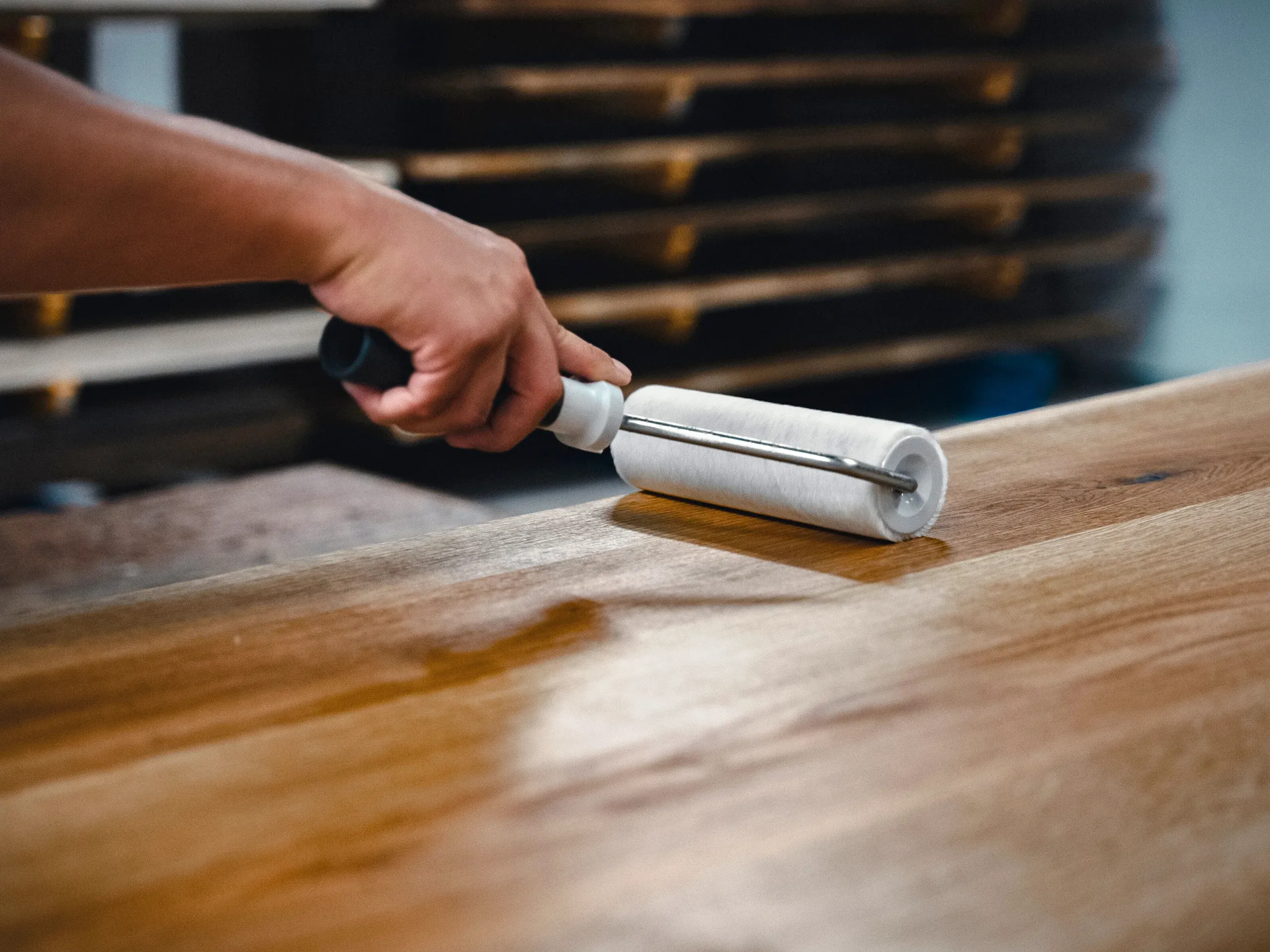
Choosing the right vitrifier for wood tables is crucial for an optimal result. At VitaDeco, we use Blanchon's, Océanic raw wood vitrifier, known for its quality and natural finish. Apply the product using an 18 cm roller to guarantee even coverage. Be sure to spread the vitrifier smoothly without leaving marks. Hard-to-reach areas, such as corners or edges, should be treated with a wide brush for a flawless finish. This product creates a water-resistant protective layer while preserving the wood's natural look.
3/ Finishing and drying
For an optimal result, it's essential to respect the drying times between each coat of raw wood vitrifier. Apply three to four coats, with a 4-hour interval between each. This allows the product to properly penetrate and harden. This technique ensures lasting protection and a smooth, ultra-matte finish that showcases the wood grain. Be sure to let the table dry for several hours before handling or using it. This waiting period guarantees a perfectly set vitrification.
Once vitrification is complete, a few simple steps are all it takes to maintain the table day to day: discover them in maintaining a wood table.
Which vitrifier should you choose for your dining table?
Choosing the right vitrifier is crucial to guarantee the durability and good looks of your solid wood table. Among the best options, Blanchon's Océanic raw wood vitrifier stands out for its superior quality. This product is particularly well suited to oak or acacia tables. Indeed, it effectively protects the wood while preserving its natural appearance. Its smooth, ultra-matte finish enhances the wood grain, creating an elegant, water-resistant finish.
This vitrifier is ideal for dining tables. Why? Because it resists stains, water and scratches, while being easy to maintain. What's more, it applies evenly and dries quickly. It offers lasting protection with a slightly satin look that preserves the wood's raw appearance.
If you're looking for an eco-friendly product, the Rubio Monocoat range offers protective oils. But for maximum protection, a dining table vitrifier remains the best solution for a piece of furniture subject to heavy daily use.
Why trust VitaDeco with the finish of your made-to-measure table?
Unmatched craftsmanship
At VitaDeco, we combine traditional craftsmanship with modern techniques to design unique solid wood tables. Every table is carefully worked on in our workshop. We therefore offer finishing options such as vitrification, protective oil, or a hardening primer. We take care to preserve the wood's natural beauty, while ensuring long-term durability. Our expertise guarantees made-to-measure finishes that meet your expectations for quality and good looks.
Made-to-measure options suited to your needs
Wherever you live, VitaDeco lets you create the ideal made-to-measure dining table and have it delivered. Our delivery partners are available across France. They guarantee you'll receive your solid wood table, ready to be set up in your dining room. Enjoy one-of-a-kind furniture, designed to your taste and needs, without having to travel.
Contact us today by email or phone to book an appointment at the workshop. Let's talk through your ideas and bring to life the dining table that's perfectly suited to your space and your style!
Theme
Key points
Why vitrify
Water-resistant barrier against stains, scratches and moisture; enhances the grain; makes everyday upkeep easier
Preparatory sanding
120 grit, along the direction of the grain, then careful dusting (Cleaner or dry cloth)
Application
18 cm roller for large surfaces, wide brush for corners and edges
Drying
3 to 4 coats, with 4 hours of drying time between each coat
Recommended product
Océanic raw wood vitrifier (Blanchon), natural ultra-matte finish; eco-friendly alternative: Rubio Monocoat oils
Frequently Asked Questions
Can you apply another coat of vitrifier over a table that's already vitrified but has superficial scratches?
Yes, if the scratches are truly superficial. You first need to lightly sand the whole surface (120 to 150 grit) so the new coat adheres, dust it off, then apply a thin coat of a suitable vitrifier. Full sanding gives a more even result than a simple localised touch-up.
Does vitrifier darken the colour of the wood?
Yes, even a colourless, matte vitrifier tends to slightly warm the wood's tone, particularly on light species such as oak. To limit this effect, a matte water-based varnish or a "raw wood effect" oil preserves the original colour better.
Should you lightly sand between two coats of vitrifier?
Yes, this is strongly recommended. A light key-sanding with 150-180 grit between each coat removes small rough patches, ensures better adhesion of the next coat, and gives a smoother, more even finish.
What alternative should you choose to avoid darkening a light wood like oak or mango?
A matte or ultra-matte water-based varnish, or a special light-wood oil with a "raw wood" effect, protect the table while preserving its original colour as much as possible. Solvent-based products, on the other hand, tend to warm and darken the wood.
How many coats of vitrifier should you apply?
Generally 3 to 4 coats, with a drying time of 4 hours between each, for lasting protection and a smooth, even finish.
We are making an appointment at the workshop.
58 Pasteur Street
69780 Saint Pierre de Chandieu
We advise and assist you
to choose the best size
for your future table
We advise you
on the choice of wood type
for your tray
What type of foot will accompany
your tray to complete
the table of your dreams
Once the table is created,
we are preparing it for you so that it is
absolutely perfect
We are delivering your table
at home, or you can pick it up
to the workshop directly
Book an appointment at the workshop
Do you have an idea, specific size constraints or simply want a truly unique table? Come and discover our solid wood tabletops, explore our different table bases and let’s discuss your project together. Every VitaDeco table is designed to suit your interior — not the other way around.

 D C27/08/2025
Trustindex vérifie que la source originale de l'avis est Google.
Un grand merci à Vincent et son équipe de Vitadeco ! Nous avons trouvé dans leur atelier près de Lyon la table en bois parfaite, et elle nous a été livrée rapidement en Savoie. Enfin une belle table qui correspond exactement à ce que nous cherchions : élégante, solide et pleine de charme. Bravo pour la qualité du travail et le service irréprochable 👌✨Publié sur Google
 Gaelle M.19/08/2025Nous sommes ravis de notre achat et de la livraison de notre table sur mesure ! Tout a pu se faire à distance - nous aurions adoré voir l'atelier en personne mais habitant à Paris ce n'était pas simple... Vincent et son équipe sont des passionnés et cela se ressent ! Merci encore.Publié sur Google
 sami charef24/07/2025Très satisfait concernant l'achat de ma table. Livraison efficace sur paris. Je recommande.Publié sur Google
 Arnaud16/06/2025Très bons conseils et énormément de choix. Toutes les tables sont magnifiques. Merci encore!!Publié sur Google
 Valerie bournel BoSson03/05/20255 années de recherche pour trouver une belle table, un bel objet comme on dit et à un prix raisonnable, merci Vincent Esposito, un pro.Publié sur Google
 Ghislaine Réveil02/04/2025Nous sommes enchantés de notre table (diamètre 110 cm). Établissement très sérieux de la confection à la livraison, à recommander sans hésitation.Publié sur Google
 Break Viss02/04/2025We came all the way from Paris and found our dream table with the help of Vincent. He was incredibly patient during our visit, pulled out table after table for us to explore, until we found the right one with the right legs. In the end we chose a beautiful table made of wood over 100 years old; it's a piece that oozes history and that has texture and character that you will not find if you buy "off the rack" in some overpriced designer store. The price was extremely competitive compared to what you find in stores in Paris, if you were to be able to find something like this in the first place. I highly recommend VitaDeco to anyone considering buying a custom table in France!Publié sur Google
 Tis 5528/03/2025Je suis très contente de l'achat de ma table chez vitadeco qui correspond tout à fait à mes attentes. Compter environ un peu plus de 1mois pour la fabrication d une table sur mesure et de qualité. Un très bon contact avec Vincent qui est toujours de bon conseil pour les clients.J'étais un peu plus septique pour la livraison à mon domicile en Marne mais cela s'est très bien passé par cocolis. Je recommande vivement cette entreprise.Publié sur Google
 Clément I13/12/2024Nous sommes enthousiasmé par la table que nous a fabriqué Vitadeco. Nous avons pu échanger, discuter et finaliser les choix de composition de notre table. Vitadeco se distingue particulièrement par sa disponibilité et son professionalisme. Nous recommandons vivement cette entreprise pour vos projet.Publié sur Google
 Marion BRAIRE07/12/2024Nous possédons une table ( en bois avec pieds en métal) achetée chez Vita Déco il y a plusieurs années, et elle est restée à l’identique! Très bon rapport qualité-prix et fabricant très sympa. On recommande!!!Publié sur Google
Hello,
J’ai une table qui est déjà vitrifiée; Mais il y a quelque rayures superficielle. Puis-je passer une couche de vitrificateur sur la vitrification actuelle ou faut_il tout poncer et recommencer à zéro.
Thank you
Hello,
Thank you for your question! 😊
If the scratches are very superficial, it's possible to apply a new layer of varnish over the existing one. However, it's essential to lightly sand the entire surface with fine-grit sandpaper (type 120 to 150) so that the new layer adheres properly. There's no need to sand down to the raw wood, unless the scratches are deep.
Next, dust thoroughly, then apply a thin layer of varnish suitable for the type of wood and the desired finish.
For a truly uniform and long-lasting result, we still recommend lightly sanding the entire surface rather than just a localized touch-up.
Happy renovation!
Hello, congratulations on your website and your answers to questions.
So I'll go ahead and put mine down
Je suis entrain de rénover une vieille table en chêne et ses deux bancs. Je l’ai sablé sauf le plateau qu’on a poncé
I'm advised to apply a primer before Whitening Varnish.
Qu’en pensez vous ? Ou es ce que 3/4 couche de vitrificateur peuvent suffire ?
What are the pros and cons of a hard floor, please?
Thank you for your response
Valerie Beaupertuit
Hello, you can apply a hard base coat, as this provides a good preparation for the wood against UV rays. You will need to apply at least two coats, and you can go up to three for a flawless finish.
I wish you a great renovation! 😉
Hello, congratulations on your website and your answers to questions.
So I'll go ahead and put mine down
Je suis entrain de rénover une vieille table en chêne et ses deux bancs. Je l’ai sablé sauf le plateau qu’on a poncé
I'm advised to apply a primer before Whitening Varnish.
Qu’en pensez vous ? Ou es ce que 3/4 couche de vitrificateur peuvent suffire ?
What are the pros and cons of a hard floor, please?
Thank you for your response
Valerie
Hello,
Je rénove actuellement ma table en chêne, l’aspect brut est magnifique mais lorsque je passe le vitrificateur, elle devient trop jaune/orangée… J’ai choisi un vitrificateur mat sans teinte pourtant.
Thank you for your advice!
Hello,
Thank you for your message! This is quite a common issue with oak: even with a colorless, matte varnish, the wood tends to warm up its tone when in contact with the product, hence this slightly yellow or orange finish.
Here are some possible solutions:
In summary, if you want to maintain the raw and clear tone of your table, opt for “raw wood effect” or “invisible effect” products.
Feel free to let us know what you choose, it might also help other readers!
Bonjour, je viens de fabriquer un plateau de table de salon en chataîgnier. J’ai plusieurs questions sur le finitions :
1) Pour les finitions le vendeur m’a conseillé de le vitrifier pour le protéger. Cependant, le vitrificateur qu’il m’a vendu est un vitrificateur pour parquet (BLANCHON VP polyurethane, mat soie cire naturelle). Est ce que ce produit est bien adapté pour une table sur laquelle je vais manger tous les jours ?
2) I really like the light color of my table. Will vitrification drastically change its hue? If so, are there alternatives to vitrification?
3) Quid de la remontée des tanins ? Le vendeur m’a dit que les produits supposés bloquer la remontée des tanins sont plus ou moins des arnaques qui ne fonctionnent pas. Comment gérez vous cette problématique dans vos ateliers ?
Merci d’avance pour vos conseils.
Sincerely
Mathieu BOUTTIER
Hello Mathieu, thank you for your message and congratulations on making your chestnut wood tabletop 👏
Regarding floor varnish: most polyurethane varnishes can indeed be suitable for a table. Just make sure it's indicated as suitable for indirect food contact (this is often the case for products intended for interior surfaces). For everyday use, it's better to stick with finishes designed to resist stains and frequent cleaning.
2️⃣ For the tint: all varnish will tend to lightly sand the wood, even with a matte finish. If you want to preserve the light color as much as possible, you can consider a colorless oil or varnish specifically for furniture. «Raw effect» or «invisible» oils generally preserve the original color better than traditional varnishes.
3️⃣ Regarding tannin runoff: chestnut wood is indeed known for releasing a lot of it. We don't work with this wood ourselves, as it's more difficult to stabilize and less commonly used in contemporary furniture than oak, acacia, or mango wood. We prefer these woods for their reliability and aesthetic appeal. We know that there are «Anti-tannin» primers» supposed to limit the phenomenon, but we are not specialists in this species and cannot guarantee their effectiveness on chestnut trees.
In summary: your product may be suitable, but if you want to best preserve the light shade and limit maintenance, a special furniture oil finish can sometimes be an interesting alternative.
Good luck with your project!
Hello
Je restaure une table dont le plateau et les 6 pieds sont en noyer massif. Les pieds ont été sablés le plateau poncé ( il subsiste des tâches comme de la graisse que je n’arrive pas à retirer, j’hésite à mettre du sel d’oseille). Une vitrification est elle recommandée ? La couleur n’est pas uniforme, elle passe du très clair au plus foncé. Merci de votre aide en m’orientant vers un produit précis.
Sincerely
Hello,
Thank you for your message and for the trust you are placing in your project.
Here is what I can advise you on vitrifying a solid walnut tray:
Regarding vitrification: yes, it's a possibility, especially if you want maximum protection against stains, wear, or heat.
However
2️⃣ Regarding the non-uniform color: Walnut naturally has variations in shade (light/dark). If you like this variation, it's a plus.
If you wish to harmonize the tone before finishing, additional sanding or a light treatment (e.g., sealer or primer) could help.
3️⃣ Regarding grease stains: before any finishing, it is important that the surface is perfectly clean. Using «sorrel salt» is not a standard recommended method for this type of wood. Prefer: light targeted sanding + gentle degreasing + neutralization + complete drying.
4️⃣ Another option: oil (or hard wax oil) can better preserve the natural look of the wood (visible grain, «living» feel) but offers less protection and requires regular maintenance.
👉 In summary: yes, varnishing can work very well for your solid walnut table. But be aware of the implications: potentially altered color, a more «filmy» finish, and appropriate maintenance.
Beautiful restoration to you!
Hello,
Should I do a light sanding (150-180 grit) between coats?
Thank you
Hello Fabien,
Yes, it's strongly advised 👍
Between two coats of varnish, a light sanding with grit 150 to 180 allows:
– to remove any small raised bumps or wood fibers,
– to ensure better adhesion of the next layer,
– and obtain a smoother, more uniform finish.
A gentle sanding, without pressing, followed by careful dusting, is sufficient before applying the next coat.
Good vitrification 🙂
Hello,
Je souhaite protéger au maximum des plans de travail de cuisine en merbau contre l’eau et les graisses.
Can you confirm that Blanchon floor varnish is suitable?
Merci d’avance pour vos conseils.
Serge
Hello Serge,
Thank you for your message.
Yes, Blanchon wood varnish can be suitable for protecting a merbau countertop, provided you choose a product designed for heavily used surfaces (ideally a high-resistance varnish or one specifically for countertops).
Some important points to keep in mind:
Since merbau is a fairly dense and naturally oily wood, it is also advisable to test on a small area before treating the entire surface.
Good preparation, and don't hesitate if you have any other questions!
Hello, we just sanded a coffee table made of oak and marble. We really like the very light result.
What protective measures to take
So she doesn't get discouraged
Thank you for your response
Hello,
Very nice project, the sanded oak indeed gives a very light and natural finish 👍
To preserve this shade without it darkening, it's important to choose a finish that doesn't yellow the wood.
We advise you instead:
These products protect the table while preserving the natural color of the oak as much as possible after sanding.
To avoid:
If you have any doubts, don't hesitate to test on a small area or a scrap piece of wood before full application.
All the best with your project 🙂
Hello,
J’ai une table et un buffet en manguier brut, qui meublent ma salle à manger.
Les deux ont été tachés au fil du temps, surtout par un plateau de décoration posé sur le buffet.
J’ai l’intention de les poncer en suivant vos recommandations.
Néanmoins je souhaite garder la couleur naturelle du manguier et je ne sais pas avec quel produit je peux les protéger.
Pouvez-vous me conseiller.
Merci pour votre site très instructif.
Hello,
Très bonne démarche 👍 le ponçage va déjà vous permettre de retrouver un manguier propre et beaucoup plus homogène.
Pour conserver sa couleur naturelle, le point clé est le choix de la finition.
👉 Nous vous conseillons :
Ces produits protègent efficacement tout en évitant de foncer le bois. Le manguier ayant déjà une teinte chaude, l’objectif est vraiment de ne pas l’accentuer davantage.
⚠️ À éviter :
👉 Petit conseil : faites toujours un test sur une zone peu visible après ponçage, le rendu peut varier selon le bois.
Avec la bonne finition, vous garderez un manguier naturel tout en le protégeant durablement au quotidien 🙂
Bonne rénovation !
Hello,
j’ai une table basse en TECK sur laquelle les enfants mettent leurs pieds au bord en regardant la télé, de ce fait, elle est toute abîmée sans doute a-t-elle absorbée le gras des pieds, je voudrais la reponcer et mettre un produit Qui empêcherait ce phénomène pouvez-vous m’aider ?
Hello,
Oui, c’est un phénomène assez fréquent sur le teck 🙂
Le bois absorbe naturellement les corps gras, surtout lorsqu’il n’est plus suffisamment protégé en surface.
La bonne solution est effectivement de :
Dans votre cas, pour limiter au maximum les traces de gras et l’absorption au quotidien, nous vous conseillerions plutôt un vernis mat ou ultra-mat de qualité, à base d’eau, plus résistant qu’une huile sur ce type d’usage.
Une huile conservera un aspect plus naturel, mais protégera moins efficacement contre les traces grasses répétées.
Pensez aussi à bien dégraisser le plateau avant le ponçage si les taches sont importantes, afin d’éviter qu’elles ne restent visibles après finition.
Avec une bonne préparation et une finition adaptée, votre table retrouvera un aspect propre et sera beaucoup plus facile à entretenir au quotidien !
Hello,
Merci pour votre site plein de conseils, ma question est la suivante :
J’ai une table de salle à manger (je ne pense pas que ça soit du chêne) qui a déjà été vitrifiée par quelqu’un mais nous nous retrouvons avec une « pâte » noire à l’endroit des frottements des avants-bras.
Au départ, je pensais que c’était un dépôt des avants bras mais, si je gratte avec l’ongle, j’ai l’impression qu’il n’y a plus de protection à cet endroit.
Ça fait vraiment sale si je laisse comme ça et ça m’ennuie de gratter car on voit une différence avec le reste et, je pense, que la table n’est plus protégée à cet endroit.
Comment faire et quel produit utiliser ?
Bien cordialement.
Hello,
Merci pour votre message, et ravi que l’article ait pu vous aider 😊
Ce phénomène est assez fréquent sur les tables déjà vitrifiées. Ce que vous décrivez ressemble souvent à une usure localisée du vitrificateur liée aux frottements répétés des avant-bras, combinée à l’accumulation de graisse naturelle et de salissures qui finissent par noircir la zone.
Le fait que vous puissiez “gratter” la surface avec l’ongle indique effectivement que la protection est probablement altérée à cet endroit.
Le mieux est généralement d’éviter de gratter uniquement les zones noircies, car cela crée souvent des différences de teinte et de finition. Nous vous conseillons plutôt de :
• poncer légèrement toute la surface concernée (grain fin type 120 à 180),
• bien dépoussiérer,
• puis appliquer un nouveau vitrificateur de qualité sur l’ensemble du plateau pour retrouver un rendu homogène et une protection durable.
Pour une table de salle à manger, nous recommandons un vitrificateur ultra-mat qui conserve l’aspect naturel du bois tout en protégeant efficacement des frottements et des taches. Dans notre atelier, nous utilisons notamment l’Océanic Bois Brut de Blanchon, qui offre un rendu très naturel et une bonne résistance au quotidien.
Petit conseil également : avant de revitrifier toute la table, faites un essai discret sur une petite zone pour vérifier la compatibilité avec l’ancienne finition. Certaines anciennes protections peuvent nécessiter un ponçage un peu plus complet avant réapplication.
Bonne rénovation à vous 😊