
How is a tabletop made?
In short
Making a solid wood tabletop follows a precise multi-step process: selecting the wood species (oak, acacia, mango or reclaimed wood), cutting it into strips to limit the wood's natural warping, preparing them (jointing then planing for an even thickness), assembling by gluing and clamping for several hours, and finally the finishing touches: sanding then vitrifying. It's this sequence that guarantees a stable, flat, long-lasting tabletop.
The secret to a long-lasting tabletop
Crafting a solid wood tabletop goes far beyond selecting a simple plank of wood. The process relies on precise assembly, ensuring strength and stability. Each step is essential—from selecting the wood species to gluing the boards together—in order to create a tabletop that will stand the test of time.
In this article, discover how the assembly technique transforms a raw sawmill board into an exceptional tabletop, ready to enhance your interior. Learn why this method is key to creating a tabletop that is both aesthetic and durable.
1. Choosing the wood species: the foundation of quality
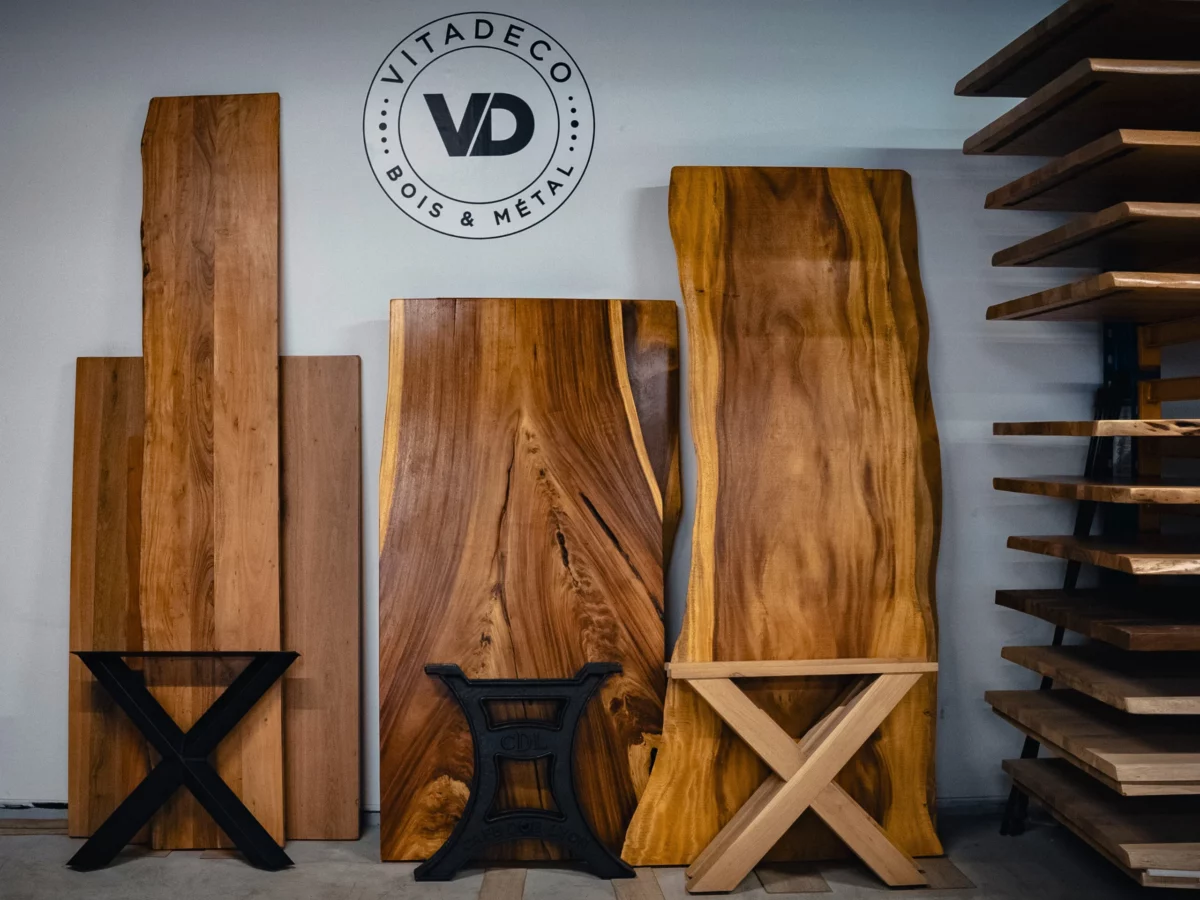
Choosing the wood species is a key step in crafting a custom tabletop. Each species has its own characteristics, combining strength, aesthetics, and durability:
- Light oak: valued for its density and timeless elegance, it brings a warm and refined touch to any interior.
- Acacia: known for its exceptional durability, it stands out with its rich and varied color tones.
- Mango wood: robust and exotic, it fits perfectly into modern or ethnic interiors.
- Reclaimed wood: ideal for an eco-friendly approach, it adds a unique and authentic character, rich in history.
This initial choice is crucial: a well-selected species ensures a strong, stable, and harmonious tabletop. It influences both the tabletop’s resistance over time and how well it integrates into your interior design.
In this way, each tabletop begins with a careful selection of solid wood, laying the foundation for a table that is both functional and aesthetically pleasing.
To choose the wood species best suited to your project, check out our full guide which wood to choose for a dining table.
2. Cutting into boards: the key to stability
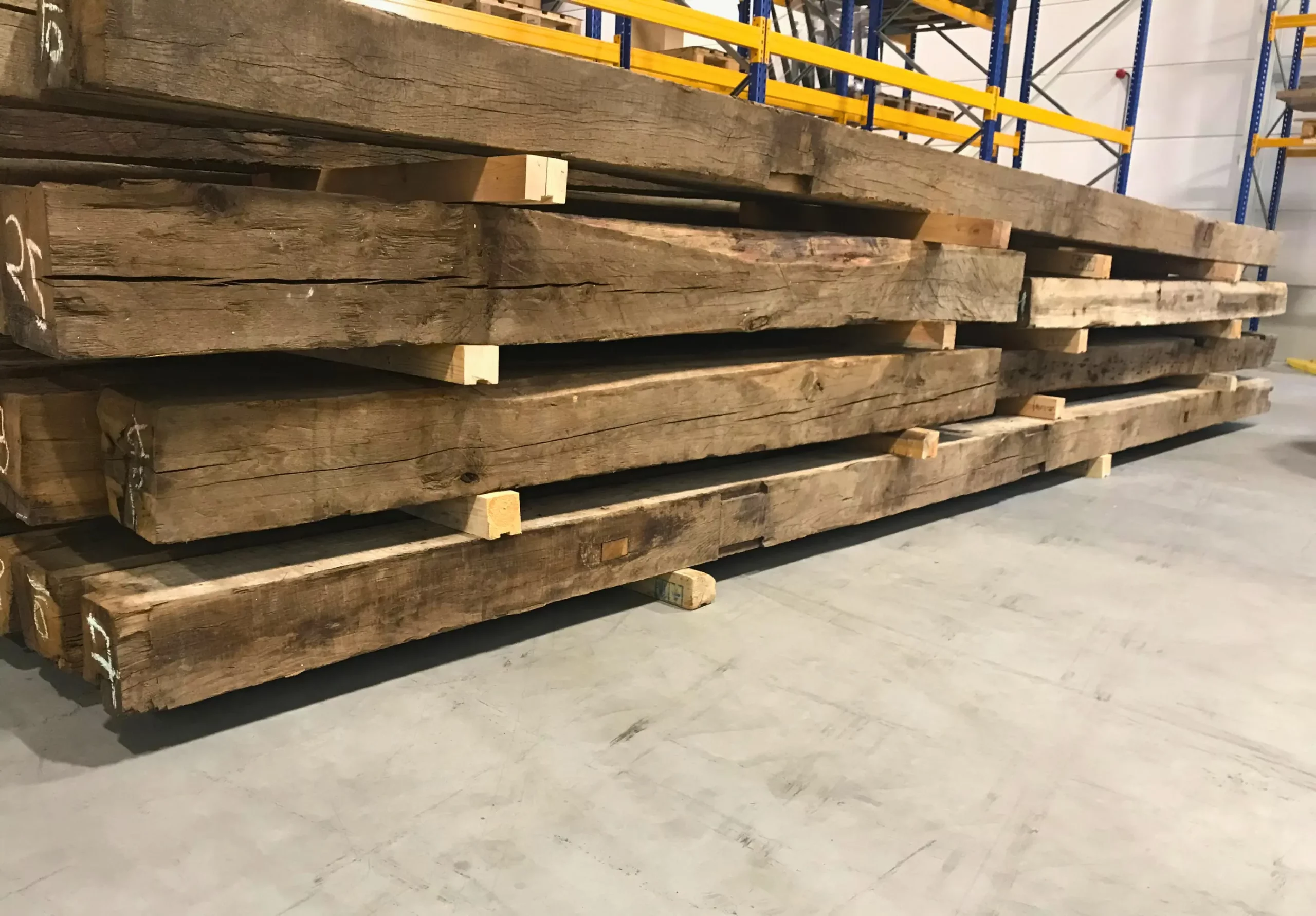
A durable tabletop relies on an essential method: cutting the wood into boards. Unlike a single raw sawmill plank, this technique helps prevent warping caused by the natural movement of the wood. By cutting the grain, internal tensions are reduced, ensuring a stable and straight tabletop over time.
The boards must be carefully selected for their quality and alignment. This step is crucial to ensure a strong assembly, capable of withstanding everyday use. It is through this meticulous process that each tabletop retains its flat shape and offers exceptional durability.
3. Preparing the boards
Jointing: removing warping
Jointing is the first step in preparing boards for assembly. This process removes warped or irregular parts of the wood. By working on each board individually, it ensures a perfectly flat surface—essential for a strong and flawless assembly
Planing: achieving a uniform thickness
After jointing comes planing, which refines each board to a consistent thickness. This process ensures that all the boards fit together seamlessly, creating a perfectly flat tabletop. These preliminary steps are essential for crafting a solid wood tabletop capable of withstanding the test of time and everyday use.
4. Assembly: the birth of the tabletop
Precise gluing of the boards
To create a durable solid wood tabletop, each board must be carefully aligned and glued using a specialized wood adhesive. This step ensures a strong bond between the boards, capable of withstanding natural tension and everyday wear. The assembly is carried out with precision to guarantee a uniform and harmonious surface.
Clamping: securing with clamps
After the boards are glued, sturdy clamps hold them firmly in place for several hours. This even pressure allows the adhesive to dry properly, creating a stable and flat tabletop. This precision in the assembly process gives the tabletop its strength and longevity, preparing it to withstand everyday use with elegance.
What finishes does VitaDeco offer for a tabletop?
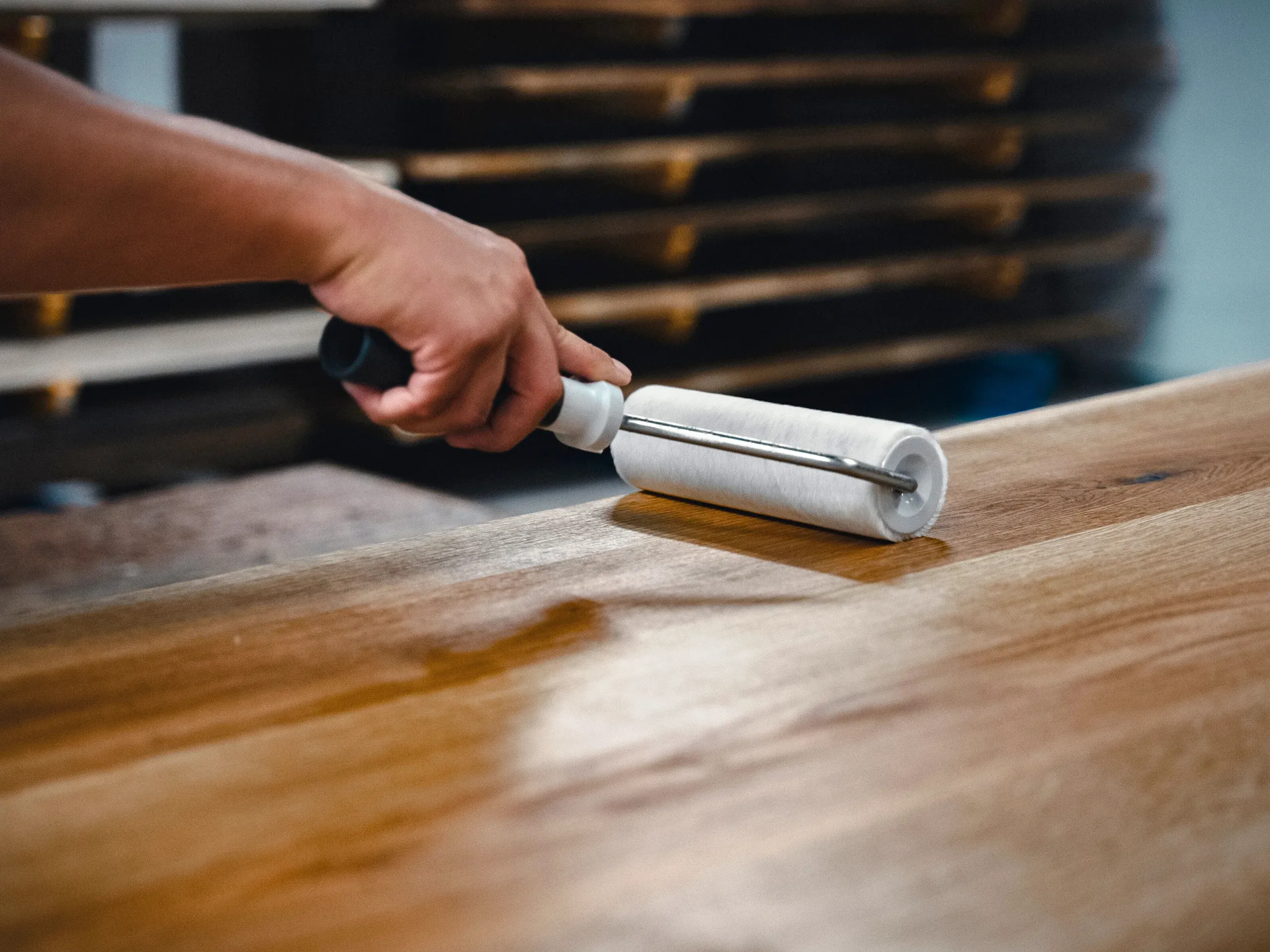
Once the tabletops are assembled, they come to VitaDeco for an essential step: sanding. Carried out with a rotary sander, this precise work starts with a coarse grit (80) to remove irregularities, then finishes with a fine grit to achieve a perfectly smooth surface. Sanding is a key finishing step: find all our advice in how to sand a solid wood table.
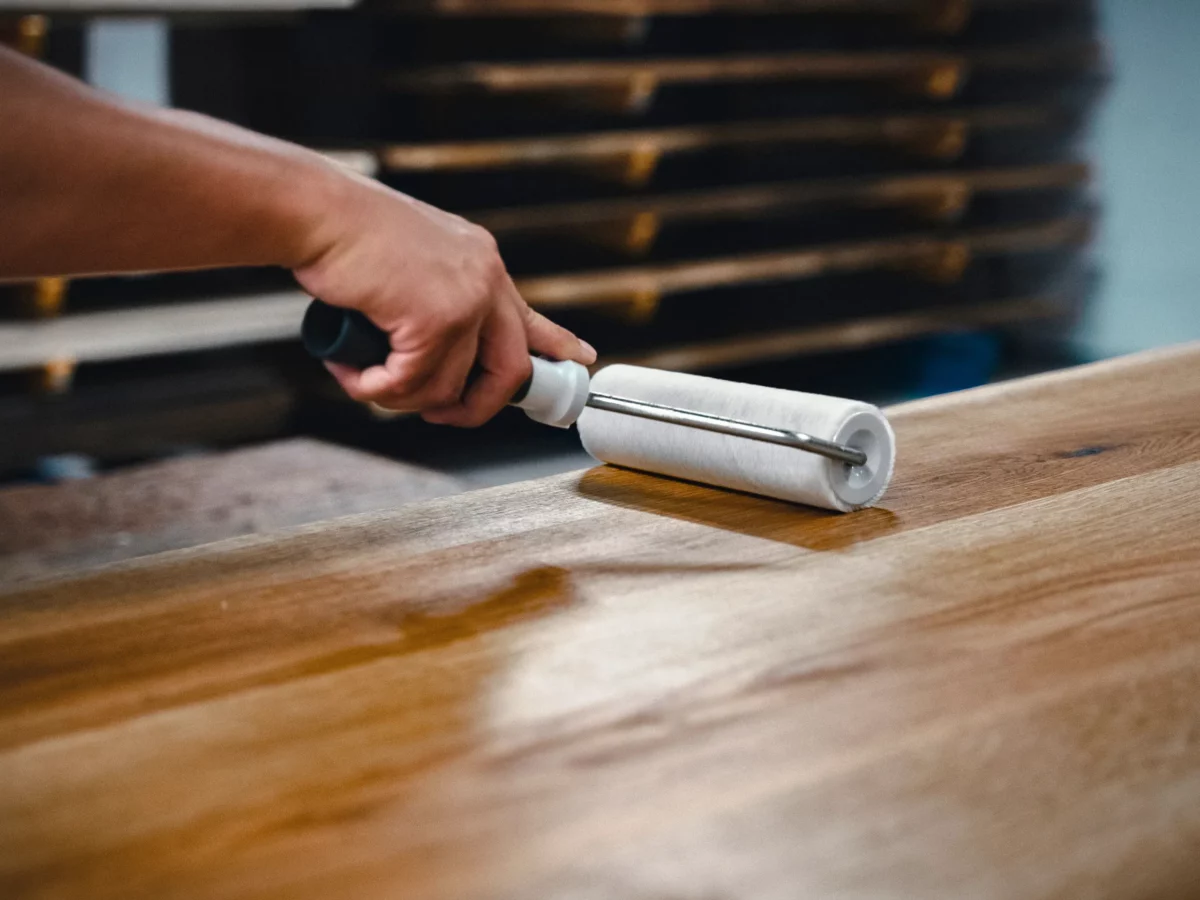
After sanding, the tabletop is cleaned with a clean cloth to remove all dust. It is then ready for the final treatment: varnishing. Applied with care, this process enhances the natural beauty of the wood while providing long-lasting protection. You can also explore our practical tips for maintaining your wooden table to preserve its beauty over time.
Why trust VitaDeco for your solid wood table?
Unique craftsmanship dedicated to your interior
Crafting a stable and durable solid wood tabletop is a demanding process that requires precision and expertise. At VitaDeco, we work exclusively with carefully assembled and prepared tabletops to ensure their longevity. We take great care in enhancing each solid wood piece with a finish tailored to your needs, making sure every table reflects both your style and our commitment to quality.
Custom solutions and delivery across France
With VitaDeco, design a unique table that perfectly matches your space and your vision. Whether you’re drawn to premium wood species such as oak, acacia, or mango wood, or prefer the eco-friendly character of reclaimed wood, we support you at every step—from the choice of tabletop to the final finish. In addition, thanks to our specialized delivery partners, your custom-made table can be shipped anywhere in France, ready to enhance your interior.
Contact us and bring your ideas to life
Want a made-to-measure table? Contact VitaDeco today to talk through your ideas and discover the world of solid wood, carefully crafted at the workshop. With VitaDeco, every table becomes far more than a piece of furniture — it's a true creation that tells a story: yours.
Step
What happens
1. Selecting the wood species
Oak, acacia, mango or reclaimed wood, each with its own qualities of sturdiness and looks
2. Cutting into strips
The wood is cut into strips to limit natural warping and guarantee a stable tabletop over time
3. Preparing the strips
Jointing (removing irregularities) then planing (even thickness)
4. Assembly
Precise gluing of the strips, then held together with clamps for several hours
Finishes
Sanding (80 grit then a finer grit), cleaning, then vitrifying
Frequently Asked Questions
Why is wood cut into strips to make a tabletop?
This technique prevents warping linked to the wood's natural movement. By cutting across the grain, internal tension is reduced, guaranteeing a stable, straight tabletop over time.
What is jointing a wood strip?
It's the step that removes twisted or uneven parts of the wood, to achieve a perfectly flat surface, essential for solid assembly.
How long do the clamps stay in place during assembly?
Several hours. This even pressure allows the glue to set properly and guarantees a stable, flat tabletop.
What grit of sandpaper is used to sand a new tabletop?
Sanding starts with a coarse grit (80) to remove irregularities, then finishes with a finer grit to achieve a perfectly smooth surface.
Which wood species should you choose for a tabletop that's both durable and eco-friendly?
Reclaimed wood is the most environmentally conscious option, while also bringing a unique, authentic character. Oak, acacia and mango also remain durable choices, each with a different look.
We are making an appointment at the workshop.
58 Pasteur Street
69780 Saint Pierre de Chandieu
We advise and assist you
to choose the best size
for your future table
We advise you
on the choice of wood type
for your tray
What type of foot will accompany
your tray to complete
the table of your dreams
Once the table is created,
we are preparing it for you so that it is
absolutely perfect
We are delivering your table
at home, or you can pick it up
to the workshop directly
Book an appointment at the workshop
Do you have an idea, specific size constraints or simply want a truly unique table? Come and discover our solid wood tabletops, explore our different table bases and let’s discuss your project together. Every VitaDeco table is designed to suit your interior — not the other way around.

 D C27/08/2025
Trustindex vérifie que la source originale de l'avis est Google.
Un grand merci à Vincent et son équipe de Vitadeco ! Nous avons trouvé dans leur atelier près de Lyon la table en bois parfaite, et elle nous a été livrée rapidement en Savoie. Enfin une belle table qui correspond exactement à ce que nous cherchions : élégante, solide et pleine de charme. Bravo pour la qualité du travail et le service irréprochable 👌✨Publié sur Google
 Gaelle M.19/08/2025Nous sommes ravis de notre achat et de la livraison de notre table sur mesure ! Tout a pu se faire à distance - nous aurions adoré voir l'atelier en personne mais habitant à Paris ce n'était pas simple... Vincent et son équipe sont des passionnés et cela se ressent ! Merci encore.Publié sur Google
 sami charef24/07/2025Très satisfait concernant l'achat de ma table. Livraison efficace sur paris. Je recommande.Publié sur Google
 Arnaud16/06/2025Très bons conseils et énormément de choix. Toutes les tables sont magnifiques. Merci encore!!Publié sur Google
 Valerie bournel BoSson03/05/20255 années de recherche pour trouver une belle table, un bel objet comme on dit et à un prix raisonnable, merci Vincent Esposito, un pro.Publié sur Google
 Ghislaine Réveil02/04/2025Nous sommes enchantés de notre table (diamètre 110 cm). Établissement très sérieux de la confection à la livraison, à recommander sans hésitation.Publié sur Google
 Break Viss02/04/2025We came all the way from Paris and found our dream table with the help of Vincent. He was incredibly patient during our visit, pulled out table after table for us to explore, until we found the right one with the right legs. In the end we chose a beautiful table made of wood over 100 years old; it's a piece that oozes history and that has texture and character that you will not find if you buy "off the rack" in some overpriced designer store. The price was extremely competitive compared to what you find in stores in Paris, if you were to be able to find something like this in the first place. I highly recommend VitaDeco to anyone considering buying a custom table in France!Publié sur Google
 Tis 5528/03/2025Je suis très contente de l'achat de ma table chez vitadeco qui correspond tout à fait à mes attentes. Compter environ un peu plus de 1mois pour la fabrication d une table sur mesure et de qualité. Un très bon contact avec Vincent qui est toujours de bon conseil pour les clients.J'étais un peu plus septique pour la livraison à mon domicile en Marne mais cela s'est très bien passé par cocolis. Je recommande vivement cette entreprise.Publié sur Google
 Clément I13/12/2024Nous sommes enthousiasmé par la table que nous a fabriqué Vitadeco. Nous avons pu échanger, discuter et finaliser les choix de composition de notre table. Vitadeco se distingue particulièrement par sa disponibilité et son professionalisme. Nous recommandons vivement cette entreprise pour vos projet.Publié sur Google
 Marion BRAIRE07/12/2024Nous possédons une table ( en bois avec pieds en métal) achetée chez Vita Déco il y a plusieurs années, et elle est restée à l’identique! Très bon rapport qualité-prix et fabricant très sympa. On recommande!!!Publié sur Google